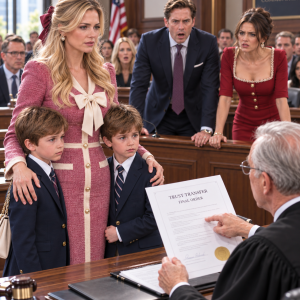
He looked back at me once, then at Connor.
I moved another half step so Connor disappeared completely behind my shoulder.
Richard was taken downstairs to answer questions concerning the property transfers and allegations of forged documents.
I watched the elevator doors close.
Then I turned around.
Connor was holding Elliot’s sleeve.
“Mr. Mercer?”
“Yeah?”
“Was that him?”
I nodded.
“Yes.”
He looked toward the closed elevator.
“Why did he take my picture?”
I didn’t know.
And I wasn’t going to lie to him.
“We’re going to find out.”
The Envelope in the Sewing Box
Tommy called me that afternoon.
His voice sounded different.
“James, I found something.”
I drove to his house.
It was smaller than I expected, with a sagging porch step and an old window air conditioner rattling in the front room. Connor’s backpack was hanging from the kitchen chair.
Tommy had placed an old wooden sewing box on the table.
“This was my mom’s.”
He opened it.
Under spools of thread, buttons and fabric scraps was a yellowed envelope.
Someone had written on the front in blue ink.
FOR CONNOR — WHEN HE IS OLD ENOUGH.
Connor stood beside the table.
“That’s Grandma’s handwriting.”
Tommy didn’t open it immediately.
“She never told me this was here.”
Inside was a letter and a small brass key.
Tommy read the first page silently.
Then he sat down.
“What?” I asked.
He handed me the letter.
Connor’s mother had written it before she died.
Most of it was meant for Connor.
She wrote about his father.
Connor had spent years believing the simplest explanation: his dad had left because he didn’t want a family.
The letter said otherwise.
Years earlier, Connor’s father had discovered irregularities connected to the property records around the rail corridor. Richard had pressured him to stop asking questions. According to the letter, the threats eventually became specific enough that Connor’s father believed staying near his family would put them in greater danger.
So he disappeared.
Not because he didn’t want Connor.
Because he thought leaving would protect him.
Connor watched Tommy’s face.
“What does it say?”
Tommy looked at me.
Then he pulled out the chair beside him.
“Come here, buddy.”
Connor sat.
Tommy placed the letter between them.
“Your dad didn’t leave because of you.”
Connor didn’t move.
“What?”
“Your mom says he was threatened.”
Connor stared at the page.
“But she told me he was gone.”
“She was trying to keep you safe.”
Connor swallowed.
“So he wanted me?”
Tommy reached for him.
Connor pulled back slightly, not because he didn’t want comfort, but because he was still looking at the letter.
“He wanted me?” he asked again.
Tommy’s voice broke.
“Yeah, buddy. He did.”
Connor covered his eyes with both hands.
I looked away.
Elliot was standing beside me.
After a moment, he walked around the table and sat next to Connor.
He didn’t say anything.
He just stayed there.
The brass key was later connected to a safe-deposit box containing original family property records. Those documents became important in establishing the legitimate ownership history and challenging the disputed transfer.
I won’t pretend everything was fixed overnight.
It wasn’t.
Investigations take time. Property disputes take time. Richard’s conduct became part of a broader investigation involving several transactions in the neighborhood.
But Tommy’s house was protected while the disputed transfer was challenged.
And Tommy passed his interview.
He didn’t need my help with that part.
Karen called me afterward.
“He’s good.”
“How good?”
“Good enough that I’m annoyed you found him before recruiting did.”
He started the following Monday.
The First Full Refrigerator
About three weeks later, I stopped by Tommy’s house after work.
He opened the door wearing a Mercer Logistics polo.
“You’re late,” I said.
He checked his watch.
“By three minutes.”
“I’m docking your pay.”
He laughed.
It was the first time I’d heard him do that.
Connor was at the kitchen table doing homework with Elliot.
The old refrigerator hummed behind them.
Connor opened it to get juice.
I saw milk, eggs, vegetables, sandwich meat, yogurt and a large container of leftover pasta.
Nothing remarkable.
That was exactly why I remembered it.
Connor took two juice boxes and shut the refrigerator without studying what was inside.
He handed one to Elliot.
Then they went back to their homework.
Tommy noticed me watching.
“First full grocery trip after my paycheck cleared,” he said quietly.
I nodded.
He didn’t thank me.
I was glad he didn’t.
Months earlier, I might have described what happened at Brennan’s as helping somebody.
I don’t anymore.
Connor had needed food that afternoon, yes.
But Tommy had needed stable work.
His family had needed somebody to take a forged signature seriously.
And Connor had needed one old letter to tell him something no child should have spent years doubting.
Mercer Logistics eventually created an employee assistance initiative we called the Open Door Program. It connected workers facing temporary food insecurity, housing problems or family emergencies with existing resources and practical assistance.
I didn’t put Connor’s name on it.
That story belonged to him.
The Table by the Window
Several months after the afternoon we met, I took Elliot and Connor back to Brennan’s Grill.
We ended up at almost the same table.
Connor had grown a little. His sneakers were new, although one lace was already permanently gray. He ordered a cheeseburger, fries and a chocolate shake.
When the food arrived, he didn’t touch it immediately.
He looked toward the window.
I followed his eyes.
The public trash can was still outside.
Connor looked at Elliot.
“You know what I remember about that day?”
Elliot dipped a fry into ketchup.
“What?”
“You didn’t stare at me.”
Elliot frowned.
“When?”
“When I was eating.”
Elliot thought about it.
“You looked hungry.”
Connor smiled.
“I was.”
That was all Elliot had to say about it.
A few minutes later, Connor looked at me.
“Mr. Mercer?”
“Yeah?”
He hesitated.
“Can I just call you James?”
I smiled.
“I’d like that.”
He nodded and went back to his burger.
I watched him for a while.
The first time I had seen that boy, he had been on the other side of this same window with somebody else’s discarded food in his hands, glancing over his shoulder every few seconds as if he expected someone to tell him he shouldn’t be there.
Now there was a full plate in front of him.
Elliot was stealing his fries.
Connor slapped his hand away.
“Dude. Get your own.”
“You ate mine the first day we met.”
“That was different.”
“How?”
“I was a guest.”
Elliot looked at me.
“Dad, tell him that’s not how fries work.”
I laughed.
Connor did too.
Then he picked up his burger and kept eating.
He never looked over his shoulder once.
And sitting there by that window, I finally understood that the most important thing we’d given Connor that first afternoon wasn’t the hamburger, the job interview or even the help that came later.
It was a seat at the table.
Sometimes a child doesn’t need someone to promise him the whole world.
He just needs one person in a crowded room to notice he’s still standing outside—and open the door.