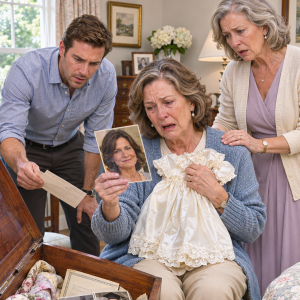
He showed me copies of the agreement, canceled checks, and letters he’d sent over the years.
Then he opened a folder containing the letter he believed I’d written when I turned eighteen.
It said I appreciated his financial help but didn’t want further contact. It asked him to respect my decision and stop writing.
The signature at the bottom was supposed to be mine.
It wasn’t my handwriting.
Samuel watched me examine it.
“You didn’t write that?”
“No. I didn’t even know you existed.”
He closed his eyes.
For several moments, neither of us spoke.
Then he told me he’d sent money specifically intended to help with my education. He believed the fund would be available when I reached adulthood.
I showed him the scanned ledger pages.
He looked through them slowly, stopping at the entries associated with Paige’s tuition.
“I didn’t know about this,” he said.
I believed him, although I understood that determining exactly what happened to the money would require proper financial records and professional advice.
We spent the afternoon talking.
Samuel showed me photographs of Marianne, told me about her love of reading, and explained why she’d chosen the name Hannah. It had belonged to her grandmother, a woman who’d taught her to read when she was little.
For thirty-three years, I’d believed my mother chose my name because she liked a song.
Now I knew someone had loved that name long before I was born.
Before I left, Samuel gave me a photograph of Marianne holding me.
I placed it inside the brown folder beside the agreement.
On the drive home, I cried harder than I had in years.
Not simply because of the money or the hidden letters, but because I’d spent my childhood believing I should be grateful that anyone wanted me.
Someone had wanted to know me all along.
Over the following week, I organized the records and spoke with an attorney about the financial questions. She cautioned me that a private agreement and family ledger weren’t enough to establish every legal obligation or determine where all the funds had gone.
But she agreed the documents justified further investigation, especially the education-related entries and the correspondence that had apparently been withheld.
I wasn’t interested in making accusations I couldn’t support.
I wanted the truth.
I called Mom and asked whether we could talk privately before the anniversary party.
She sounded irritated.
“Hannah, I’m busy. We’ve got sixty people coming Saturday, and Paige is handling everything.”
“It’s important. It’s about my childhood.”
She sighed.
“What about it now?”
“I found some documents that don’t match what you’ve told me.”
There was a pause.
“What documents?”
“I’d rather discuss them in person.”
Her voice cooled.
“If you’re digging up old family business, this isn’t the week for it.”
“Then can we meet Sunday?”
“We’ll see. Don’t spoil our anniversary with another one of your grievances.”
She ended the call.
I sat with the phone in my hand, remembering how many times I’d accepted that tone as the end of a conversation.
This time, I didn’t.
I prepared a short written summary of what I’d found and placed it in the folder. I also made copies of the agreement, relevant ledger entries, and the letter Samuel believed I’d sent.
I decided I wouldn’t bring up the matter publicly unless my parents once again turned my childhood into entertainment.
I hoped they wouldn’t.
Saturday evening, I arrived at Willow Cove Restaurant near Knoxville shortly before six.
Paige stood at the entrance wearing a coral dress and holding a clipboard. She greeted me with a distracted smile and pointed toward the seating chart.
“You’re at table nine.”
The family table was near the front, beneath the projection screen. Mom, Dad, Paige, her husband, and several relatives were seated there.
My name wasn’t among them.
Table nine was beside the swinging kitchen doors.
I sat with several employees from Dad’s business and their spouses. They were pleasant company, but when the slideshow began, I found myself watching the family I’d spent weeks arranging into photographs.
Mom had selected 120 pictures.
I appeared in four.
One had been cropped so that only part of my face remained.
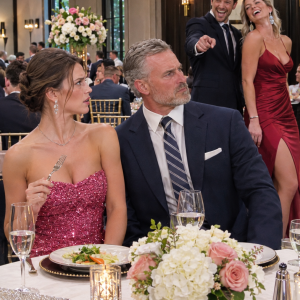
Then the anniversary speeches began.
Paige thanked everyone for coming and talked warmly about our parents’ marriage. Aunt Ruth, Dad’s older sister, raised her glass and wished them many more years together.
For a moment, I thought the evening might pass peacefully.
Then Mom stood.
She thanked the guests, praised Paige for organizing the celebration, and began telling stories about raising two daughters.
I knew what was coming when she looked toward my table.
“Of course, Hannah was our little surprise,” she said with a laugh. “We always joked that we only took her in because somebody was paying us!”
People laughed.
Dad leaned toward the microphone.
“And she certainly didn’t inherit Paige’s brains. Thank goodness our real daughter got the smart genes.”
More laughter followed.
I looked toward Aunt Ruth.
She wasn’t smiling.
I reached into my handbag and removed the folder.
Then I stood.
“That’s interesting,” I said. “Because I found the original agreement.”
Mom’s smile vanished.
Dad lowered the microphone.
“What agreement?” he asked.
I walked toward the front of the room, stopping several feet from their table.
“The agreement you and Mom signed with Samuel Whitaker in March 1993. The one that provided monthly support for my care and required you to give me his letters.”
Mom set down her glass.
“Hannah, this is neither the time nor the place.”
“I tried to arrange a private conversation. You refused.”
She looked around the room.
“We are celebrating thirty-five years of marriage. Have some decency.”
I held the folder against my chest.
“I’ve spent thirty-three years listening to you make jokes about why you took me in. Tonight, you made another one in front of sixty people. I’m simply telling you I found the paperwork behind it.”
Dad rose slowly.
“What exactly are you accusing us of?”
“I’m asking why I never received seventeen birthday letters. I’m asking why you told me there was no college fund when the records show one. And I’m asking why money associated with that fund appears alongside Paige’s tuition payments.”
The room became very quiet.
Paige stared at me.
“What money?”
Mom turned sharply toward her.
“Don’t listen to this nonsense. Hannah has always had a talent for misunderstanding things.”
I opened the folder and placed a copy of the ledger on the table.
“Then help me understand it.”
Dad picked up the page.
His eyes moved down the entries.
“Judith, what’s this?”
Mom reached for the paper.
“Frank, not here.”
“Did Samuel send fifty-two thousand dollars for Hannah’s education?”
She looked toward the guests.
“We made financial decisions for the family. That’s what parents do.”
Paige stood.
“Mom, you told me Aunt Mildred paid for college.”
“She helped,” Mom snapped.
“Then why does Hannah’s fund show the same amount as my tuition?”
Mom didn’t answer.
I hadn’t expected Paige to challenge her. For years, I’d assumed my sister would automatically defend our parents, but she looked genuinely confused.
Dad put the paper down.
“Hannah, where did you get these?”