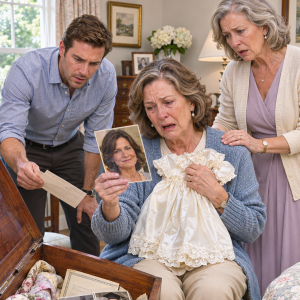
“From the cedar chest in Mom’s closet. I also spoke with Samuel. He has copies of the agreement and payment records.”
Mom stared at me.
“You went through my private belongings?”
“I found a letter addressed to me in the photographs you gave me. It said there were others. I looked for them, and I found sixteen more, all opened and hidden.”
Her expression hardened.
“You had no right.”
“I understand why you’re angry I searched the chest. But that doesn’t explain why you kept my letters.”
Aunt Ruth stood beside the table.
“Judith, answer her.”
Mom looked at her with disbelief.
“You stay out of this.”
“I’ve stayed out of it long enough.”
Aunt Ruth’s voice wasn’t loud, but people heard her.
“You made that joke when Hannah was five. I told you to stop then. You never did.”
Mom turned toward Dad, apparently expecting him to intervene.
Instead, he was still studying the ledger.
“Judith,” he said quietly, “did we use that education money for Paige?”
“We used money where it was needed. Paige had a real opportunity at a good university.”
I felt the words settle between us.
A real opportunity.
For a moment, I was eighteen again, standing in the laundry room while my mother told me to be realistic about my abilities.
“And I didn’t?” I asked.
Mom looked at me.
“Hannah, you struggled in school. We were trying to make practical decisions.”
“I graduated from college while working full-time.”
“Nobody said you didn’t.”
“Dad called my degree a certificate. You told people I worked with computers because you couldn’t be bothered to remember my job title.”
Dad lowered his eyes.
Mom’s mouth tightened.
“After everything we did for you, you’re going to stand here and humiliate us?”
I looked around the room.
The people who’d laughed at the jokes were watching quietly now.
“I didn’t come here to humiliate you,” I said. “I came to celebrate your anniversary. You’re the ones who decided my childhood should be the entertainment.”
I closed the folder.
“I’m not going to discuss the rest in front of your guests. But I won’t laugh along anymore, and I won’t pretend these questions don’t exist.”
I turned to Paige.
“I don’t blame you for going to college. You didn’t know what Mom told me or what these records show.”
Her eyes filled.
“Hannah, I really didn’t know.”
“I believe you.”
Then I looked at my parents.
“You’ll receive copies of the documents. I’m asking for a proper accounting, and I expect you to answer my questions honestly.”
I returned to my table, collected my handbag, and left.
Nobody applauded.
Nobody made a dramatic speech.
But as I walked toward the restaurant doors, I heard Aunt Ruth say something I’d wanted someone to say for most of my life.
“That girl deserved better.”
The weeks afterward were difficult.
Mom called several times, insisting I’d embarrassed the family and damaged her reputation at church. She wanted me to apologize publicly before she’d discuss anything else.
I declined.
Dad, however, began asking questions.
He met with the attorney handling the financial review and examined records from the business and family accounts. He admitted that he’d signed the original agreement but had left most of the bookkeeping to Mom.
That didn’t excuse his part in what happened.
He knew Samuel was sending money. He’d repeated the jokes. He’d accepted Mom’s claims about my abilities without questioning them.
Eventually, Dad and Mom began living separately while they worked through the financial dispute.
Paige called me one evening and cried.
“I thought Aunt Mildred left the money,” she said. “If I’d known it was meant for you, I never would’ve let them use it.”
“You were eighteen, Paige. They told you your tuition was covered. You had no reason to investigate.”
She was quiet for a moment.
“I think I let Mom convince me you didn’t want to go to college.”
“I wanted to go more than anything.”
“I know that now. I’m sorry I never asked.”
We didn’t become close overnight, but we began talking without Mom directing the conversation.
I continued visiting Samuel in Asheville. He showed me Marianne’s old photographs, letters, and maps of places she’d loved. We talked about the choices he’d made and the years we’d lost.
He didn’t ask me to forgive him immediately.
I appreciated that.
In late August, a letter arrived from Dad.
Inside was a cashier’s check for $52,000.
He’d sold his fishing boat, the one he’d bought for himself when he turned sixty.
A short note accompanied it.
This money was meant for you. I should’ve checked the records a long time ago.
The following afternoon, Dad came to my apartment carrying a shoebox.
Inside were Samuel’s sixteen birthday letters and the blue atlas.
“These belong to you,” he said.
I lifted the atlas carefully.
“Thank you.”
He stood awkwardly in the doorway.
“I believed what your mother said about you because it was easier than checking. I didn’t ask enough questions.”
I looked at him.
“No, Dad. You didn’t.”
He nodded.
It wasn’t a perfect apology. It didn’t erase the years of jokes or give me back the opportunities I’d missed.
But he had returned something concrete, acknowledged his responsibility, and stopped asking me to pretend nothing had happened.
I accepted the check as repayment of the identified college fund, while leaving the remaining financial questions to be reviewed properly.
Then I carried the shoebox inside.
That evening, I opened the atlas on my kitchen table and read Samuel’s inscription again.
For Hannah, for all the places your mind will take you.
I placed the photograph of Marianne beside it.
For the first time, I could look at my own childhood without hearing my parents’ jokes in the background.
A week later, I drove to Asheville with the atlas and a letter I’d written to Samuel.
We sat on his porch, turning the old pages while he told me about the mountain towns Marianne had loved.
When I handed him the envelope, he looked surprised.
“A letter? From you?”
I smiled.
“I thought it was time I wrote one back.”
He held it carefully, the way someone holds something they have waited years to receive.
I’d written about my work, the books I loved, and the places I wanted to visit. I’d told him I still had questions, but I wanted us to keep talking.
I signed it simply Hannah.
Samuel looked down at the envelope for a long time before thanking me.
Then he opened the atlas to a map of North Carolina.
“Your mother loved these mountains,” he said.
I leaned closer.
“Would you show me where she used to go?”
He smiled and traced a road with his finger.
I followed it across the page.
For thirty-three years, my parents had told me I should be grateful somebody had taken me in. They’d made my intelligence a joke and treated my future as something smaller than my sister’s.
Now, sitting beside an old man who had once given a lonely five-year-old girl a book of maps, I had something I’d never been allowed to have before.
My own history.
My own choices.
And the freedom to decide where the road went next.
I turned the page, and Samuel began telling me about the first place Marianne had wanted to visit.
This time, nobody took the book away.